By Samarjith Biswas, Research Scientist III, NewFoS
Imagine a world where sound waves can bend around corners without losing their power, where acoustic devices remain perfectly functional even when damaged, and where we can create “highways” for sound that are completely immune to interference. This isn’t science fiction—it’s the emerging reality of topological acoustics, a revolutionary field that’s transforming how we understand and control sound.
Beyond Traditional Sound Control
For decades, engineers have struggled with a fundamental problem: sound waves are fragile. They scatter when they hit obstacles, reflect unpredictably from surfaces, and lose energy as they travel through imperfect materials1. Traditional acoustic devices—from concert hall designs to noise-canceling headphones—work around these limitations rather than solving them. Topological acoustics takes a radically different approach2. Instead of fighting the laws of physics, we’re learning to bend them to our will by exploiting hidden mathematical properties of sound waves that remained invisible until recently. This field emerged from the intersection of quantum physics, materials science, and acoustic engineering, offering solutions that seemed impossible just a decade ago.
The Science Behind the Magic
At its core, topological acoustics exploits the geometric properties of materials to create “protected” pathways for sound3. Think of it like building an invisible tunnel through which sound can travel, completely shielded from the chaos happening around it. These protected states aren’t just theoretical curiosities—they’re already being demonstrated in laboratories worldwide4. The fundamental mechanism relies on topological protection, where certain properties are preserved regardless of imperfections in the material structure5. In topological acoustic systems, sound waves can propagate along interfaces between different materials with inherent robustness against defects and disorder. This phenomenon, first demonstrated by researchers creating acoustic analogues of electronic topological insulators, enables one-way edge propagation of sound that is immune to backscattering5.

Visualization of sound waves traveling along a topological interface in a phase-change material phononic crystal. Unlike conventional materials where sound scatters and reflects, topological acoustics creates “protected highways” for sound that maintain their integrity even when the surrounding material contains defects. The confined acoustic energy (shown in red and blue) propagates unidirectionally along the boundary between two different material regions, demonstrating the robust, backscattering-immune transport that makes topological acoustics revolutionary for next-generation communication and sensing technologies.
In my own research at the New Frontiers of Sound Science and Technology Center (NewFoS), we’ve been developing phononic crystals using advanced materials like phase-change glasses. These engineered structures can guide acoustic waves along specific paths with remarkable precision, maintaining their integrity even when the surrounding material is damaged or contains defects. Our recent work has shown that by carefully tuning the geometry of these crystals, we can create acoustic “switches” that route sound waves in different directions based on their frequency—like a sophisticated traffic control system for sound.
Real-World Applications That Matter
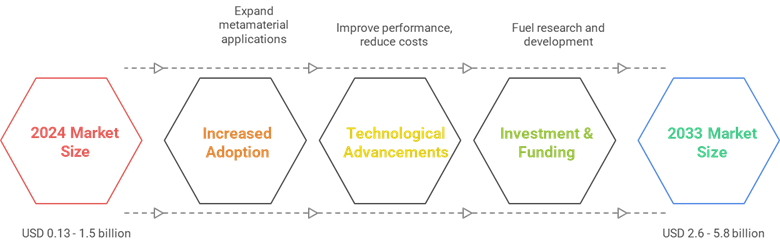
The acoustic metamaterials market shows explosive growth from 2024 to 2033, demonstrating the commercial potential of topological acoustics breakthroughs.
The applications of topological acoustics extend far beyond academic laboratories6. The global acoustic metamaterials market is projected to reach $5.8 billion by 2033, driven by revolutionary advances in noise control, communications, and sensing technologies7.
Revolutionary Noise Control
Acoustic metamaterials can manipulate and control sound waves in ways that are not possible in conventional materials. These materials can selectively block specific frequencies while allowing air flow, solving long-standing challenges in automotive, aerospace, and building acoustics. Unlike traditional soundproofing that relies on bulk and weight, topological acoustic devices can achieve superior noise control in lightweight, compact formats8 . Recent advances have demonstrated that acoustic metamaterials with periodic structures can break the mass law limit at certain frequencies, enabling high-performance sound insulation without the weight penalties of conventional materials. Companies are now commercializing metamaterial panels that control road noise and improve building acoustics using these principles.
Unbreakable Communication Systems
Researchers have successfully demonstrated acoustic topological insulators that support robust sound propagation along boundaries with inherent robustness against defects and disorders. This has profound implications for underwater communications, seismic monitoring, and even space exploration, where equipment must operate reliably in harsh, unpredictable environments9. Experimental work has shown that acoustic waveguide networks based on topological principles can maintain efficient and robust sound propagation even when structural components are damaged. These findings may offer unique applications for design of acoustic devices in guiding, switching, isolating, and filtering.
Climate and Environmental Monitoring
The Center’s work extends to critical environmental applications using topological acoustic sensing techniques. These sensors can detect subtle changes in ground conditions that indicate climate-related infrastructure risks, potentially preventing disasters before they occur. Acoustic wave sensors are increasingly used for environmental monitoring, detecting and quantifying pollutants, gases, and substances in air, water, and soil10.
The Quantum Connection
Perhaps most exciting is the potential for acoustic computing systems that rival quantum computers in processing power. NewFoS’s Project 1 demonstrates how acoustic waves can do the work of quantum information processing without the time limitations and fragility of traditional quantum systems. Researchers have demonstrated the possibility for acoustic waves to do the work of quantum information processing without the time limitations and fragility of traditional quantum systems. Recent work has shown how acoustic metamaterials can support logical phi-bits, classical analogues of quantum bits, and opening pathways for digital quantum analogue computing platforms. This “quantum analog” approach could provide the computational advantages of quantum systems without requiring the extreme conditions typically needed for quantum computers.
Breaking Down Barriers
What makes topological acoustics particularly exciting is its accessibility11. Unlike quantum computers that require temperatures near absolute zero, many topological acoustic devices operate at room temperature using conventional materials. This is where our phase-change material research provides a critical advantage – enabling room-temperature reconfigurability that was previously impossible. This means the technology can be deployed in everyday environments, from smartphones and hearing aids to building HVAC systems and automotive applications12.
Recent breakthroughs have demonstrated acoustic metamaterial devices that can be 3D printed using standard materials, making customized acoustic solutions economically viable for small-scale applications. Researchers at MIT have developed new methods using 3D printing to produce metamaterials that are both strong and remarkably stretchable, utilizing microscopic double structures consisting of rigid support scaffolds and flexible networks. Topology optimization techniques are now being used to synthesize acoustic topological insulators through free material inverse design methods, with resulting structures showing high transmission and excellent field confinement. These advances democratize access to advanced acoustic technology and open possibilities we’re only beginning to explore.
NewFoS’s Three Transformative Projects
At NewFoS, we are pioneering the future of topological acoustics through three groundbreaking problem-driven projects that address grand challenges in quantum information science, telecommunications, and environmental sensing. Our research extends to advanced chalcogenide materials like Sb₂S₃ and GeTe-Sb₂Te₃ compounds for next-generation reconfigurable photonic and acoustic components. These materials demonstrate controllable crystallization behavior at the nanoscale, enabling switches from growth-driven to nucleation-driven crystallization in thin films. This provides more precise control essential for nonvolatile, energy-efficient acoustic integrated circuits.
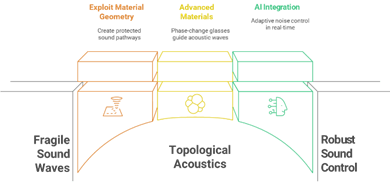
How topological acoustics bridges fragile sound waves and robust sound control.
The Path Forward
The field is moving rapidly from theoretical concepts to practical devices. NewFoS’s integrated approach combining quantum analogies, RF device development, and environmental sensing represents the most comprehensive effort to translate topological acoustic principles into real-world solutions. Academic-industry partnerships are accelerating development, with researchers demonstrating free-form acoustic topological waveguides that can take arbitrary shapes and form open arcs within lattices. These advances enable more complicated functionalities such as beam splitting and provide exciting possibilities for controlling sound propagation with extraordinary robustness.
Looking ahead, we envision acoustic devices that self-heal when damaged, communication systems that work reliably in any environment, and sensing technologies that can monitor everything from infrastructure health to climate change with unprecedented precision. The integration of artificial intelligence with topological acoustic systems promises even more sophisticated capabilities, including adaptive noise control that learns and responds to changing environments in real-time.
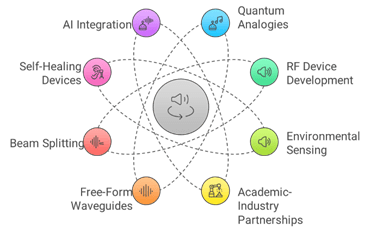
Key innovation areas are driving advances in topological acoustics research and technology.
A Personal Perspective
Working in this field feels like being at the frontier of a new scientific revolution. Every day at NewFoS brings discoveries that challenge our understanding of what’s possible with sound, particularly through our pioneering work with phase-change materials that enable unprecedented control over acoustic wave propagation. The mathematical beauty of topological protection—the idea that certain properties are preserved regardless of imperfections—has profound philosophical implications beyond acoustics. As someone who has witnessed the rapid evolution from theoretical concepts to working prototypes in phase-change acoustic metamaterials, I’m convinced we’re on the threshold of an acoustic revolution that will touch every aspect of how we interact with sound. From the headphones in our ears to the sensors monitoring our planet’s health, topological acoustics will reshape our sonic landscape in ways we’re just beginning to imagine.
The future is listening, and it sounds remarkable.
References:
1. Cummer, S. A., Christensen, J. & Alù, A. Controlling sound with acoustic metamaterials. Nat. Rev. Mater. 1, 16001 (2016).
2. Xue, H., Yang, Y. & Zhang, B. Topological acoustics. Nat. Rev. Mater. 7, 974–990 (2022).
3. Free-form acoustic topological waveguides enabled by topological lattice defects | Phys. Rev. B. https://journals.aps.org/prb/abstract/10.1103/PhysRevB.109.L180101.
4. Wei, Q., Tian, Y., Zuo, S.-Y., Cheng, Y. & Liu, X.-J. Experimental demonstration of topologically protected efficient sound propagation in an acoustic waveguide network. Phys. Rev. B 95, 094305 (2017).
5. Khanikaev, A. B., Fleury, R., Mousavi, S. H. & Alù, A. Topologically robust sound propagation in an angular-momentum-biased graphene-like resonator lattice. Nat. Commun. 6, 8260 (2015).
6. Acoustic Metamaterial Market Size [2024], Share | Global Forecast By 2033. https://www.businessresearchinsights.com/market-reports/acoustic-metamaterial-market-107174.
7. Reports, V. M. Acoustic Metamaterial Market Size, Insights, Growth & Research 2033. Verified Market Reports https://www.verifiedmarketreports.com/product/acoustic-metamaterial-market/.
8. Nakayama, M. Acoustic metamaterials based on polymer sheets: from material design to applications as sound insulators and vibration dampers. Polym. J. 56, 71–77 (2024).
9. Topological sound | Communications Physics. https://www.nature.com/articles/s42005-018-0094-4.
10. Acoustic Sensors: Enhancing Safety & Sustainability. https://sinay.ai/ https://sinay.ai/en/what-are-the-different-types-of-acoustic-sensors/.
11. Kliewer, E., Darabi, A. & Leamy, M. J. Additive manufacturing of channeled acoustic topological insulators. J. Acoust. Soc. Am. 150, 2461 (2021).
12. Architected acoustic metamaterials: An integrated design perspective | Applied Physics Reviews | AIP Publishing. https://pubs.aip.org/aip/apr/article/12/1/011340/3341034/Architected-acoustic-metamaterials-An-integrated.
 Samarjith Biswas